
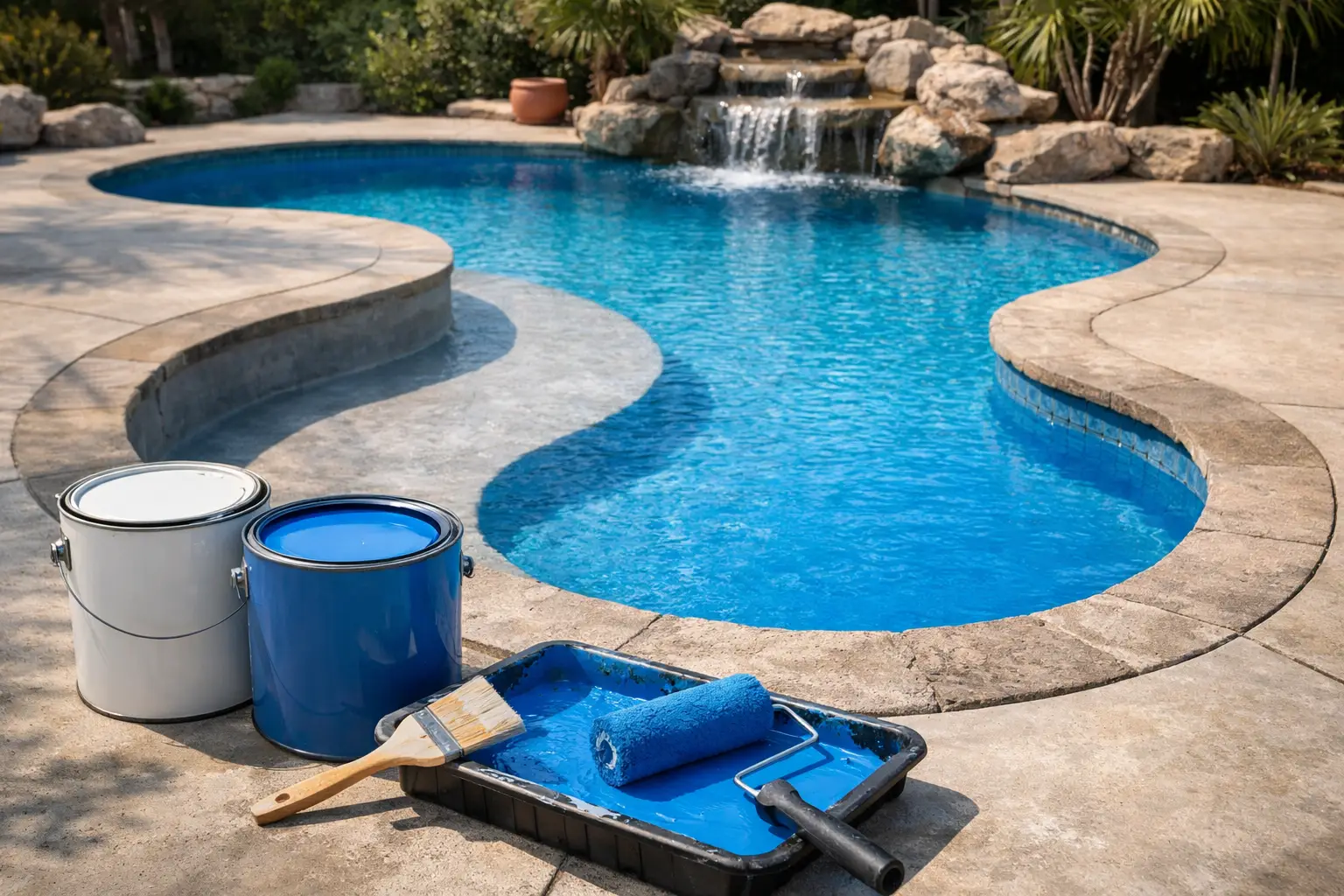
A kidney pool, freeform pool, or pool with wide steps can throw your numbers off fast. If you guess the pool paint quantity for irregular shapes, you usually end up with one of two problems – not enough paint to finish the job, or too much left over after spending more than you needed.
The fix is simple. Don’t try to calculate the whole pool as one neat shape. Break it into smaller sections, measure each one properly, then apply the real coverage rate for the coating system you’re using. That gives you a quantity you can actually trust before you buy.
Why irregular pools are harder to calculate
Most online paint calculators assume a basic rectangle. That works for some plunge pools and lap pools, but it falls apart with curved walls, beach entries, swim-outs, built-in benches, rounded ends, and sloping floors.
The biggest mistake is measuring only the waterline length and width, then multiplying them like a flat floor area. Pool painting does not work like that. You need to account for the floor, all internal walls, steps, ledges, and any feature that adds coated surface area. On an irregular pool, those extras can add a surprising amount.
If you miss them, you under-order. That can delay the job, create colour batch variation if you need more later, and make it harder to maintain the correct film build for a long-lasting epoxy finish.
How to estimate pool paint quantity for irregular shapes
The safest method is to divide the pool into manageable zones. Think of it like measuring a set of smaller shapes rather than trying to solve the whole pool in one go.
Start with the floor area. If the pool is kidney-shaped or freeform, split the floor into rough rectangles, circles, or ovals. Measure each section in metres and calculate the area separately. Then add those figures together.
Next, calculate the wall area. Measure the perimeter of each section and multiply by the average wall depth for that section. If the pool depth changes sharply, split shallow and deep ends into separate wall calculations instead of using one average for the whole pool.
Then measure all extras. This includes entry steps, benches, swim-outs, ledges, beach areas, spa spillover walls, and any curved transition surfaces. These are the areas most often forgotten, and they are exactly where many buyers come up short on paint.
Once you have total surface area in square metres, check the actual coverage rate of the pool coating system you plan to use. Coverage varies by product and by surface condition, so don’t assume all pool paints spread the same.
A practical way to measure curved pools
For a freeform pool, measure the longest length and the widest points, then sketch the shape on paper. Divide that sketch into simple sections. A rounded shallow end might be treated like half a circle. A straighter run down one side might be treated like a rectangle. Perfection is not required, but getting close matters.
If the pool has curved walls, measure along the actual wall line rather than cutting straight across the curve. A flexible tape measure helps here. If you only estimate a straight line, you will usually understate the wall area.
Where the floor slopes, measure that slope properly if possible. A sloped floor has more surface area than a flat one. On a small slope the difference may be minor, but on deep-end pools it can affect quantity enough to matter.
The formula that works in real jobs
For most repainting projects, use this basic approach:
Total paintable area = floor area + wall area + steps and features
Then multiply that area by the number of coats required.
After that, divide by the stated coverage rate per litre for the specific epoxy system.
Then add a margin for wastage and surface profile.
That last part matters. Rough or porous concrete can use more coating than smooth fiberglass. A pool that has been ground back, repaired, or patched may also absorb more material on the first coat. If you buy only the theoretical minimum, you leave no room for real site conditions.
Example calculation for an irregular pool
Say you have:
- Floor sections adding up to 42 square metres
- Wall sections adding up to 34 square metres
- Steps, bench, and swim-out adding up to 9 square metres
That gives you 85 square metres of total surface area.
If the epoxy system requires 2 coats, your total coated area becomes 170 square metres.
If the product covers 6 square metres per litre per coat under real conditions, you would need about 28.3 litres.
Then add a sensible allowance for wastage, cutting in, roller loss, and surface variation. In practice, you would round up rather than down. That is usually the difference between finishing the second coat properly and trying to stretch the last tin too far.
Coverage rates are not all equal
This is where many pool owners get caught. They calculate area correctly, then use the wrong coverage figure.
Epoxy pool paint is not the same as acrylic pool paint or a general-purpose coating. Different solids content, surface profile, and application method all affect spread rate. Even within epoxy systems, actual coverage can vary depending on whether you are coating smooth fiberglass or older concrete that has seen years of wear.
That is why the right product choice comes before the final quantity check. If you are repainting a concrete pool, use the coverage rate for the correct concrete pool epoxy system. If you are coating fiberglass, use the figure for the fiberglass-compatible system. Choosing the right pool paint first helps you calculate accurately and avoid ordering the wrong amount.
Common mistakes that lead to buying the wrong quantity
The first mistake is ignoring steps and ledges. These seem small but can add several square metres.
The second is using plan dimensions only. Pool interiors are three-dimensional, and paint goes on surfaces, not map outlines.
The third is forgetting the second coat. Many failed repaints happen because people try to make one thin coat do the work of two proper coats.
The fourth is relying on old paint coverage assumptions. If the previous coating is peeling, chalking, or worn thin, surface prep may expose rougher substrate underneath. That often changes how much product the job uses.
The fifth is rounding down. For pool paint, rounding down is usually false economy.
Concrete vs fiberglass quantity differences
Concrete pools often need a little more caution in quantity planning. If the surface is etched, patched, or uneven, actual coverage can drop compared with smooth surfaces. Repairs around cracks, hollow spots, or old failed paint areas can also create localised high-use sections.
Fiberglass pools are usually smoother, so coverage can be more predictable, but shape still matters. Many fiberglass shells have moulded seats, curves, and steps that increase area beyond what the top opening suggests.
If you are unsure, estimate conservatively and work from the coating system designed for that substrate. That is how you avoid costly mistakes and buy the correct system the first time.
When to add extra paint to your order
There are jobs where ordering a little extra is the smart move. That includes pools with extensive patch repairs, heavily textured concrete, complicated freeform designs, attached spas, or deep stain-blocking work where prep exposes more surface variation than expected.
It also makes sense if delivery timing could delay the project. In Australian conditions, once surface prep is done and weather lines up, you do not want the job stalled because you are short by a few litres.
Extra paint should not be guesswork, though. It should be based on the pool shape, substrate condition, and coating system requirements.
Getting the quantity right before you buy
If you want a reliable estimate, measure the pool in sections and write every figure down before ordering. Include floor zones, wall zones, depth changes, steps, benches, and any attached spa or water feature that will be coated. From there, match those measurements to the specific epoxy pool paint system you plan to use.
That approach gives you a quantity based on the real job, not a rough guess. It also helps you compare products properly and avoid under-ordering on a coating that needs a certain film build to last.
For buyers ready to move ahead, the best next step is to choose the correct epoxy system for concrete or fiberglass first, then confirm coverage against your measured surface area before placing the order. If the shape is awkward or the pool has multiple features, getting advice before you buy is a lot cheaper than fixing a shortage halfway through the job.
A careful measure now saves money, avoids delays, and gives your pool the best chance of a finish that actually lasts through an Australian summer.