
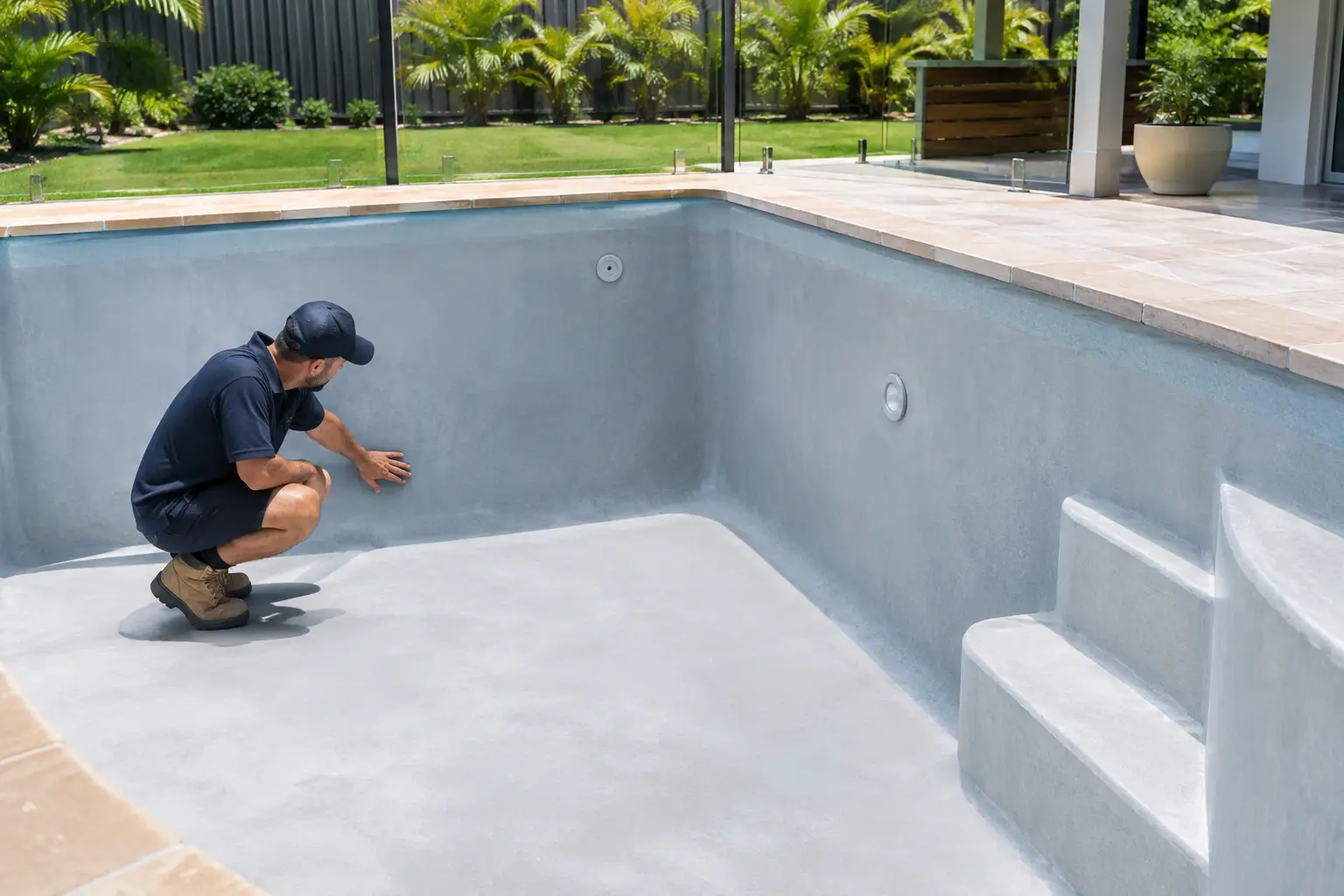
A pool coating can look excellent on application day and still fail early if it has been applied too thinly. So, does coating thickness affect durability? Yes. The finished film thickness has a direct effect on how well a pool coating stands up to water exposure, cleaning, movement in the substrate and normal wear. But applying more paint than the system allows is not the answer either.
For a durable result, the coating needs to be the correct type for the existing surface, applied at the manufacturer’s specified spreading rate, over properly prepared concrete or fibreglass. Thickness matters, but it works alongside compatibility, primer choice and preparation.
Why coating thickness affects pool durability
Pool paint protects the surface by forming a continuous film between the pool shell and the water. When that film is too thin, it has less material to resist wear and is more vulnerable to pinholes, weak coverage and early breakdown.
This is particularly relevant in an Australian pool, where a coating may face strong UV exposure while empty during preparation, hot application conditions and repeated immersion once the pool is returned to use. A thin coat may appear evenly coloured at first, yet not provide the film build the coating system was designed to achieve.
With two-pack epoxy pool paint and chlorinated rubber pool paint, the correct dry film thickness comes from applying the required number of coats at the stated coverage rate. It is not achieved by trying to stretch a tin further than its specified coverage, or by applying one heavy coat in place of a system that requires multiple coats.
What can happen when pool paint is too thin?
Insufficient coating thickness can contribute to premature wear, patchy appearance and reduced protection. On rough or porous concrete, thin application is especially common because the first coat is partly absorbed into the surface profile. If insufficient product has been allowed for, there may not be enough paint left to build an even final film.
Thin areas are also more likely around steps, corners, waterline transitions, fittings and repaired sections. These are places where roller pressure changes, paint is worked too far, or the surface texture varies.
A coating that is too thin is not automatically the reason for peeling. Peeling is more commonly tied to poor preparation, moisture issues or incompatible coatings. However, low film build gives the system less margin for error and can make an otherwise marginal job fail sooner.
Thicker is not always better
The practical goal is the specified thickness, not the thickest possible layer. Applying paint too heavily can create a different set of problems. A heavy coat may cure unevenly, trap solvent, sag on vertical surfaces or create a soft layer beneath a skin that feels dry on top.
This matters when repainting a pool because pool coatings are formulated to be applied within a particular wet-film and dry-film range. Follow the product data and recoating instructions for the chosen system. If a second coat is required, allow the required interval rather than loading excessive product into the first coat.
Do not assume an extra coat will correct an unsuitable surface or an incompatible existing coating. More paint cannot bond properly to loose, chalky or poorly prepared material underneath it.
The existing coating comes before thickness
Before calculating litres or choosing a roller, identify what is already on the pool. This is one of the most important decisions in any repainting project.
A concrete pool may be bare, previously coated with epoxy, coated with chlorinated rubber, or carry several unknown layers from earlier repaints. A fibreglass pool requires its own assessment because the existing surface may be gelcoat or a previous coating system. The new paint must be compatible with the surface beneath it.
If the old coating is peeling, blistering, soft, chalky or failing in multiple areas, do not simply paint over it at a higher thickness. Remove unsound material first and assess the stable surface left behind. Applying a premium coating over a weak layer only transfers the failure point to the new job.
Epoxy and chlorinated rubber need the right approach
Two-pack epoxy pool paint is commonly selected where a compatible epoxy system is required and the surface can be prepared correctly. It is a system that relies on accurate mixing, suitable application conditions and disciplined preparation.
Chlorinated rubber pool paint is a different coating type and should not be treated as interchangeable with epoxy. It may be suitable for pools with compatible existing chlorinated rubber coatings, but the correct choice depends on what is already present and the manufacturer’s directions.
Where the coating history is uncertain, stop before ordering. Confirm the existing surface and seek technical guidance on compatibility. Choosing the wrong system is a more expensive mistake than buying an extra tin of the correct product.
Preparation determines whether thickness can do its job
A coating only performs as well as the surface it is bonded to. Correct thickness over contamination, loose paint, dust or an unsuitable substrate is still a coating failure waiting to happen.
For a repaint, the surface needs to be sound, clean, dry and prepared in accordance with the selected coating system. Remove loose and flaking paint. Sand or abrade glossy, stable coatings where required so the new coating has an appropriate surface to bond to. Thoroughly remove sanding dust before painting.
Bare or repaired concrete may need a compatible primer before the topcoat. Primer is not simply an optional extra or a way to use less paint. Its role is to suit the substrate and support adhesion within the complete coating system. Using the wrong primer, or skipping a required primer, can undermine the result regardless of how carefully the topcoat is applied.
For fibreglass, avoid assuming that a concrete-pool preparation method will apply. The existing finish, any prior coating and the specified preparation process must guide the product choice.
How to achieve the correct coating thickness
The simplest way to get the correct film build is to apply the product at its stated coverage rate using the required number of coats. That starts with ordering enough material for the whole pool, including the floor, walls, steps, ledges and any features being coated.
Use the Pool Paint Calculator before purchasing. Measure the pool as accurately as possible and include areas that are easy to overlook. A rough surface, deep texture or repaired concrete can use more product than a smooth, previously coated surface, so allow for the actual condition of the pool rather than relying on a neighbour’s quantity estimate.
During application, work methodically in manageable sections. Maintain a wet edge and spread paint evenly rather than rolling it out until the roller is nearly dry. Pay close attention to corners, steps, vertical walls and areas around fittings. These spots often receive less paint than broad floor sections.
If you are using a two-pack system, mix only the amount that can be applied within the product’s stated working time. Trying to save mixed material beyond its usable period can affect application and finish quality.
Signs the coating may not have enough film build
A thin coating is not always obvious, but several signs should prompt a closer look during application. These include visible variation in the substrate or old colour after the required coat, roller marks that remain after the paint has levelled, dry-looking patches on porous concrete, and noticeably lighter coverage around steps or edges.
Do not judge coverage by colour alone. Some colours hide better than others, and a coat can look opaque while still being spread too far. The reliable reference is the product’s specified coverage and coat requirements, combined with accurate area measurements.
If you discover halfway through that paint is running short, do not dilute or stretch it to finish the pool. Check the measurement, surface condition and application rate, then obtain the correct additional quantity. A complete system at the right thickness is far better than a pool with one underbuilt final coat.
Buy the system, not just the paint
Durable pool repainting comes from matching four things: the existing surface, the compatible coating type, the required primer and enough product to achieve the specified film build. Missing any one of these can lead to wasted time and an early repaint.
Before ordering, identify whether the pool is concrete or fibreglass, establish the existing coating where possible, inspect for failed material and use the Pool Paint Calculator to estimate paint and primer quantities. Then select the relevant BG Coatings epoxy or chlorinated rubber system using its official product directions.
If you are uncertain about compatibility or primer requirements, resolve that question before applying the first coat. Getting the right thickness matters, but getting the right system underneath it is what gives that thickness a chance to last.