
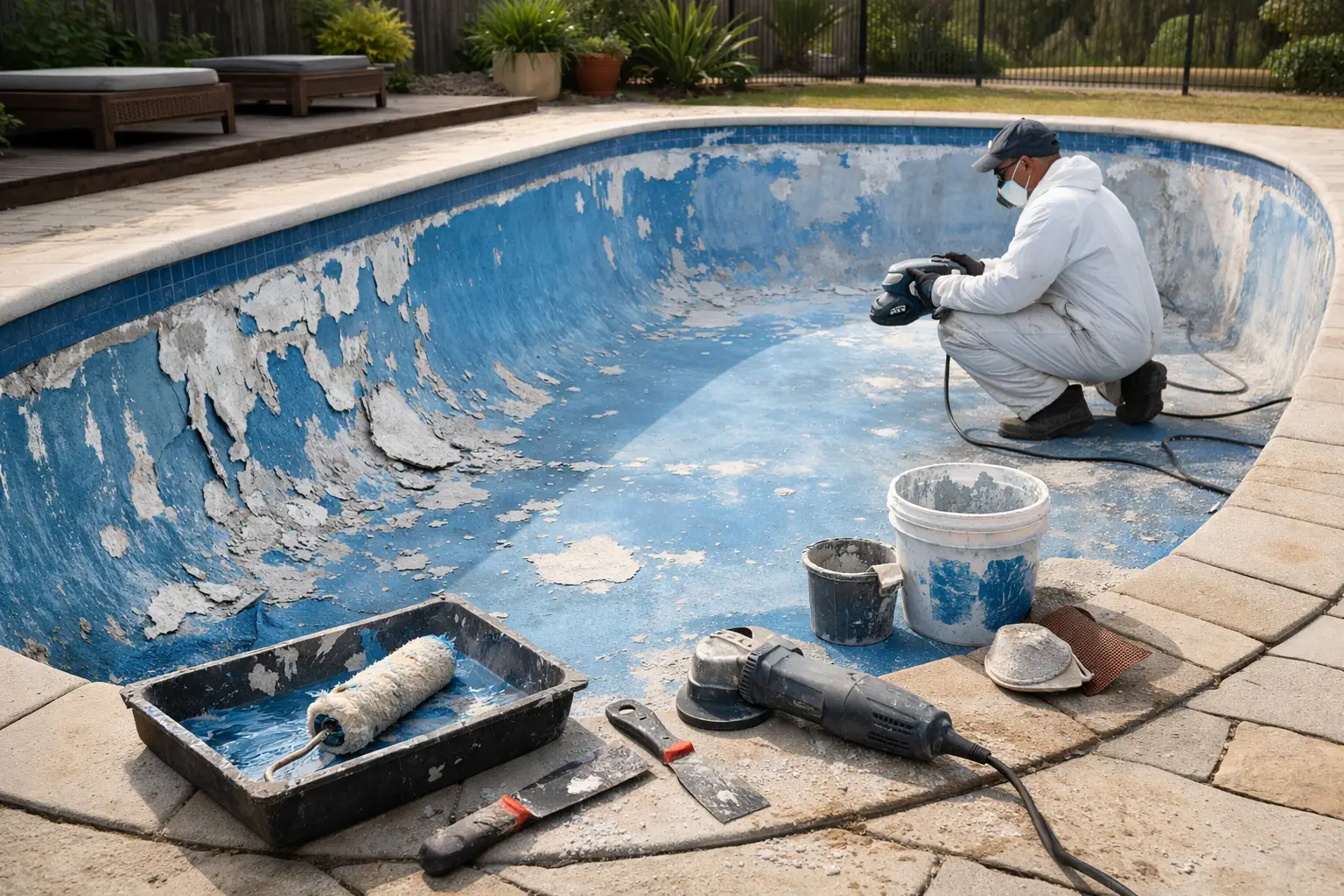
A pool coating that lifts in sheets, forms blisters or starts peeling soon after repainting is rarely just a bad tin of paint. Can epoxy pool paint fail? Yes. But in most cases, the failure started before the first coat was applied: the existing coating was incompatible, the surface was not properly prepared, moisture was present, or the epoxy system was applied outside its requirements.
Two-pack epoxy is a high-performance pool coating system, but it is not a universal fix for every old painted pool. Choosing the correct system and preparing the surface properly are what give a repainting job its best chance of lasting.
Can epoxy pool paint fail after application?
Yes. Epoxy pool paint can fail through peeling, delamination, blistering, chalking, cracking or uneven adhesion. The pattern of failure can provide useful clues, although it does not replace checking the surface and following the product data before recoating.
If paint comes away right down to bare concrete or fibreglass, the problem is often poor substrate preparation, contamination, moisture or missing primer. If the new epoxy coat lifts together with the older paint beneath it, the old coating may have been weak or unsuitable to paint over. If there are isolated bubbles, moisture, trapped air, surface contamination or application conditions may be involved.
The practical point is this: do not simply paint over a failed area and hope the next coat holds. Find out what is failing, remove unsound material and select a compatible coating system for the surface that remains.
The main reasons epoxy pool coatings fail
The existing pool paint was not identified
This is one of the most expensive mistakes in pool repainting. Existing pools may have old epoxy, chlorinated rubber, acrylic-type coatings, unknown paints or several layers of different products applied over many years. Not every coating can be safely recoated with epoxy.
A sound epoxy coating may be suitable for recoating with a compatible epoxy system after proper cleaning and abrasion. Chlorinated rubber pool paint, however, is generally a different system and should not be treated as an epoxy surface without confirming compatibility. Applying an incompatible coating can lead to softening, wrinkling, poor adhesion or later peeling.
If the existing coating cannot be identified with confidence, do not guess based on colour or age. Test a small area where appropriate, assess the condition of the paint and seek technical guidance before ordering. In some situations, removing the old coating or using the suitable alternative system is the safer decision.
Poor preparation leaves nothing sound to bond to
Epoxy adheres to a clean, stable and correctly prepared surface. It cannot compensate for loose paint, powdery concrete, chalky residue, body oils, grime, mineral deposits or sanding dust.
Preparation is not just a quick pressure wash. The pool must be empty, dry and free of contaminants. Any peeling or flaking paint needs to be removed back to a firm edge. Sound painted areas usually need to be mechanically abraded so the new coating can bond properly. Bare concrete and fibreglass require their own preparation methods, and primer requirements can differ.
A common DIY error is leaving a glossy old surface intact because it looks clean. Gloss is not proof of adhesion. If the coating is not properly keyed, epoxy may appear fine at first, then detach when the pool returns to service.
Moisture is trapped in the surface
Concrete is porous and can hold moisture long after a pool has been drained or washed down. Sydney and NSW weather can make this more difficult, particularly after rain, during humid periods or where a pool shell is slow to dry. Applying epoxy onto damp concrete can interfere with adhesion and contribute to blistering or delamination.
Moisture can also come from below or behind the coating. If a pool has a substrate or structural moisture issue, paint alone will not repair it. A coating supplier can help with product selection and preparation guidance, but structural defects and water ingress need to be addressed separately before recoating.
Do not rush the drying stage to meet a weekend deadline. Check the coating instructions, allow for actual site conditions and only proceed when the surface is suitably dry.
The wrong primer was used, or no primer was used
Primer is not automatically required for every repaint, but it is not optional where the coating system calls for it. On bare or repaired concrete, porous surfaces and certain fibreglass applications, the correct compatible primer can help create a stable base for the topcoat.
Using a non-compatible primer can be as risky as using the wrong topcoat. One product may look similar to another, but pool coating systems are designed to work as matched layers. Buy the primer recommended for the exact epoxy or chlorinated rubber system you have selected, rather than using leftover products from another painting job.
For a pool with a sound existing epoxy coating, the correct process may be cleaning, abrading and applying compatible epoxy rather than priming the whole pool. This depends on the product instructions and the condition of the existing surface.
Mixing or application was incorrect
Two-pack epoxy requires accurate mixing of its components. An incorrect mix ratio, incomplete mixing or adding unauthorised thinner can prevent the coating from curing as intended. Once mixed, epoxy also has a limited working time. Product left too long in the pot should not be stretched onto the pool just to avoid waste.
Application thickness matters as well. Applying too thinly can leave inadequate film build and reduced protection. Applying too heavily may create other problems, especially if recoat intervals, temperature and drying conditions are ignored. Follow the manufacturer’s coverage guidance and apply the specified number of coats rather than trying to make one heavy coat do all the work.
Hot Australian conditions need planning. A surface in direct sun can be much hotter than the air temperature, and wind can affect application. Start at a suitable time of day, avoid unsuitable weather and work within the product’s stated application conditions.
How to decide whether epoxy is the right repainting system
The correct paint is determined by three things: the pool surface, the existing coating and its condition. Concrete and fibreglass pools have different preparation needs. A previously epoxy-painted pool in sound condition may be a good candidate for a compatible two-pack epoxy system. A pool with an existing chlorinated rubber coating may be better suited to a compatible chlorinated rubber repainting system instead.
Epoxy can be a strong choice where the surface and existing coating are known to be suitable, and where the preparation process can be completed properly. It is less suitable as a shortcut over unknown, loose or incompatible paint.
Before you buy, work through these questions:
- Is the pool concrete or fibreglass?
- What coating is currently on the pool, and is it firmly bonded?
- Are there peeling areas, blisters, chalking or bare patches?
- Will the surface need a compatible primer after preparation?
- Can the pool be kept dry and painted within the product’s stated conditions?
If one of these answers is unclear, pause before ordering. The cost of checking compatibility is small compared with stripping a failed coating later.
Fixing a failed epoxy pool coating
The repair method depends on how widespread the failure is. Local damage with firm surrounding paint may be repaired by removing all loose material, feathering the edges, preparing the exposed surface and using the appropriate primer and topcoat system. The repair must be brought back to a clean, stable surface first.
Widespread peeling is different. If large areas are lifting, or if the old paint beneath the epoxy is releasing, spot repairs may only delay the problem. The unstable layers need to be removed and the pool reassessed before selecting the new coating system.
Do not treat a coating failure as proof that epoxy is inherently unsuitable. Often, the issue is that epoxy was applied over an unsuitable base. Equally, do not insist on epoxy if the existing coating points to chlorinated rubber as the compatible option. The right system is the one that matches the pool you actually have.
Order the right quantity before starting
Running short can leave you trying to extend paint beyond its intended coverage or buying a second batch midway through the project. Ordering far too much creates unnecessary cost. Measure the pool carefully, including walls, floor, steps, ledges and other painted areas, then use the Pool Paint Calculator to estimate the paint and primer required for the chosen system.
Check the calculator result against the product coverage information and allow for the number of coats specified. Rough, porous or heavily prepared surfaces can use more product than a smooth, previously coated pool, so surface condition matters.
Pool Paint Sydney can assist with choosing a compatible BG Coatings epoxy or chlorinated rubber system, identifying primer requirements and checking your quantity calculation before purchase. Have clear photos, pool measurements and details of the existing coating ready.
A failed epoxy coating is frustrating, but it is also a clear signal to slow down and correct the cause. Identify the old paint, remove anything unsound, prepare the surface properly and buy the coating system that suits the pool rather than the label that seems easiest.