
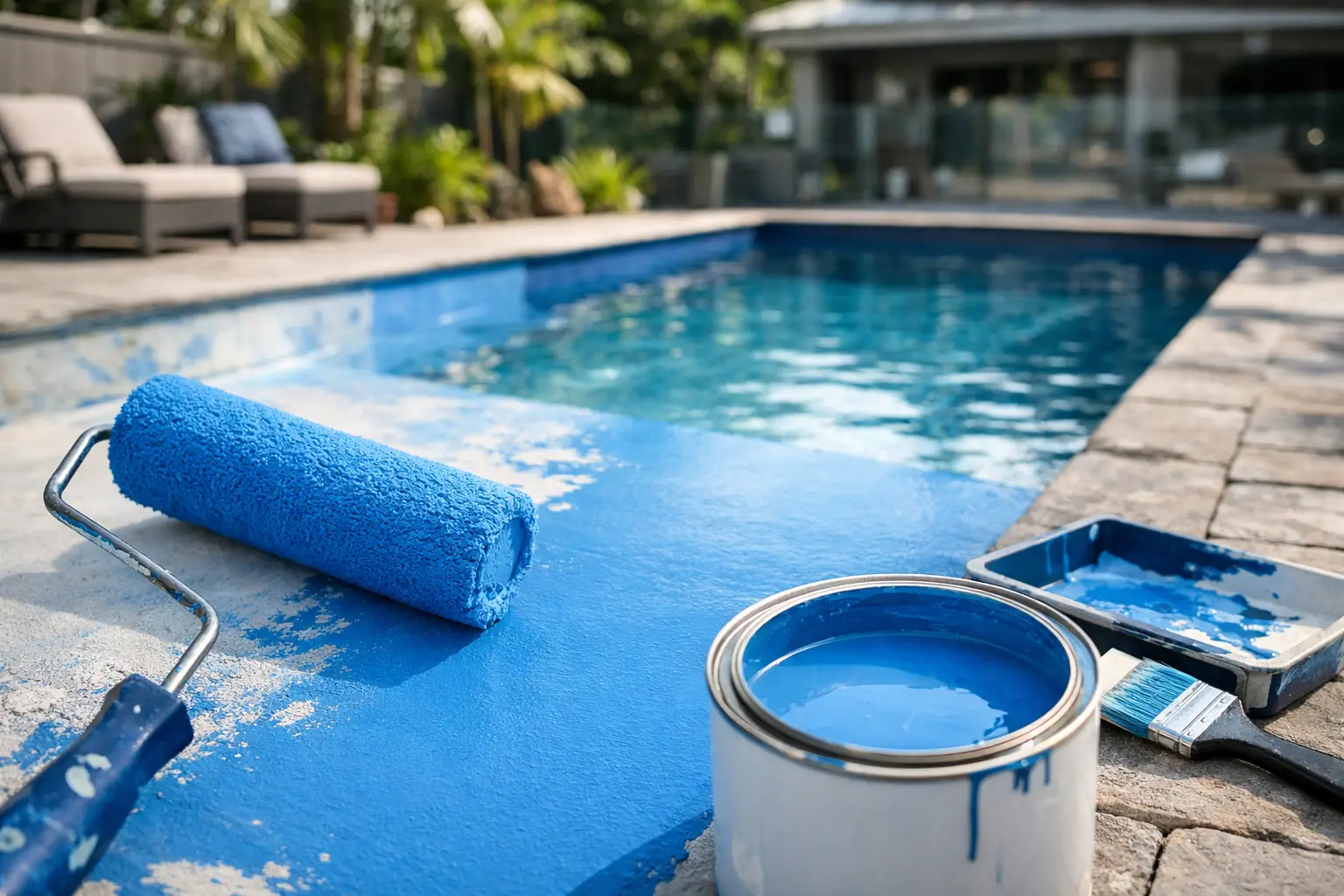
If you are searching for pool paint Sydney options, you are probably not looking for theory. You are trying to stop a pool from looking tired, fix failed paint, or choose a coating that will actually last in harsh Australian conditions. That means the real question is not just what paint to buy. It is which system suits your pool surface, its current condition, and the way the job will be prepared.
A lot of pool paint failures start before the first coat goes on. The wrong product gets chosen, old coatings are not identified properly, or surface prep is rushed. Then six or twelve months later the paint blisters, peels, chalks, or wears through. At that point, the cheapest option becomes the expensive one.
How to choose pool paint in Sydney
For most repainting jobs, the first thing to get right is the pool surface. Concrete and fibreglass do not behave the same way, and neither do old painted pools with unknown coatings.
If you are painting a bare concrete pool or repainting a concrete pool that needs a hard-wearing finish, epoxy is usually the right direction. A proper epoxy pool coating offers better resistance to chemicals, water exposure, and general wear than lower-grade alternatives. In Sydney and across Australia, that matters. UV, heat, regular pool chemical use, and seasonal temperature swings all put pressure on the coating.
If the pool is fibreglass, product compatibility matters even more. Not every coating will bond well to fibreglass, and not every old surface can simply be cleaned and recoated. You need a system designed for that substrate, with the right prep to support adhesion.
The safest way to choose the right paint is to answer three questions first. What is the pool made from? What coating is on it now, if any? And is the current problem just cosmetic, or is there widespread failure? Those answers usually tell you whether you need a straightforward repaint or a more complete repair approach.
Why pool paint fails so often
Most failed pool paint jobs come down to one of four issues – wrong product, poor prep, moisture problems, or not applying enough paint.
Wrong product for the surface
This is common on older pools. Someone uses a paint designed for one type of substrate on another, or applies a new coating over an incompatible old one. The result might look fine at first, but adhesion problems show up later.
Epoxy systems are chosen because they are tough, but they still need to match the surface and previous coating. If you are unsure what is already on the pool, guessing is risky.
Poor surface preparation
This is where many DIY jobs go wrong. A pool might be pressure cleaned and still not be ready for paint. Loose material, chalky residue, grease, calcium build-up, and unstable old paint all need to be dealt with properly. On concrete, profile matters too. The surface needs to be sound and ready to accept the coating.
Painting over a weak surface does not fix the weakness. It just hides it for a while.
Moisture and curing issues
Pools are exposed to constant water pressure and weather. If moisture is trapped in the substrate, or the surface is not fully dry when required, coating failure becomes more likely. The same goes for refilling too early. Even a good epoxy system needs the correct cure time.
Not enough paint applied
Coverage rates matter. Trying to stretch a kit too far is a false economy. If the coating goes on too thin, you reduce durability and increase the chance of patchy wear. This is especially common when buyers underestimate surface area or forget to account for slopes, steps, coves, and deep ends.
Pool paint Sydney buyers should avoid these mistakes
If you want long-lasting results, there are a few mistakes worth avoiding from the start.
Do not choose by price alone. Cheap pool paint can look attractive until you factor in prep time, labour, and the cost of doing it all again.
Do not assume any paint labelled for pools is equal. There is a big difference between a high-performance epoxy coating and a lower-grade product with a shorter service life.
Do not ignore existing paint failure. If the old coating is peeling, flaking, or bubbling, painting over it will not solve the problem. Failed layers need to be removed or stabilised correctly before recoating.
And do not estimate quantities loosely. Running short mid-job can create application problems, shade variation, and inconsistent film build.
How much pool paint do you need?
This is one of the most common buying questions, and it is a good one. Ordering too little causes problems. Ordering too much ties up money unnecessarily.
Start with the total interior surface area of the pool, not just the water volume. Measure the length, width, wall height, floor slopes, deep end, shallow end, steps, and any ledges or beach areas. A simple rectangle is easy. A freeform pool needs a more careful estimate.
Once you have square metre coverage, match that to the product coverage rate and number of coats required. Epoxy pool coatings are typically applied as a system, not as a single rushed coat. If the product data says two coats at a certain spread rate, use that. Do not plan around ideal conditions if the pool surface is rough or porous, because rough surfaces generally use more material.
If you are between quantities, it is usually better to round up rather than try to make a kit stretch further than it should.
Concrete vs fibreglass pool painting
Concrete pools
Concrete pools are often good candidates for epoxy coating, provided the surface is structurally sound and prepared properly. Older concrete pools may have multiple previous coatings, areas of patching, or chalking from age and exposure. These need to be checked before repainting.
The advantage of concrete is that, when prepared correctly, it gives coatings a solid substrate to bond to. The downside is that damaged, porous, or contaminated concrete can create adhesion issues if not treated properly.
Fibreglass pools
Fibreglass pools need a bit more care in product choice and prep. Surface gloss, contamination, and old degraded coatings can all affect bond strength. A product that works on concrete is not automatically the right choice for fibreglass.
If the shell is sound, the right coating system can restore the finish well. If the surface is already failing in multiple layers, more repair work may be needed before repainting makes sense.
When epoxy pool paint is the right choice
For buyers who want durability, epoxy is usually the system worth serious attention. It is especially suitable when you want better resistance to chemical exposure, abrasion, and everyday wear. That matters for family pools, investment properties, and tradie-managed jobs where callbacks are the last thing you want.
That said, epoxy is only as good as the prep and application behind it. If you want a coating that lasts, you need the full system done correctly – surface prep, compatible primer if required, correct mixing, proper recoat windows, and full cure before refilling.
This is why technical support matters. A lot of buyers do not need more options. They need the right answer for their pool.
What to do if your current pool paint is peeling
Peeling is not just a cosmetic problem. It is usually a sign that adhesion has already failed somewhere in the system.
Start by checking how widespread the issue is. If only a small isolated area is affected and the surrounding coating is sound, a repair may be possible. If the paint is lifting in multiple sections, blistering, or coming away in sheets, the surface usually needs more than a spot fix.
The cause also matters. Peeling from poor prep is different from peeling caused by incompatible coatings or moisture pressure. If you do not identify the reason, the next coating can fail the same way.
In practical terms, the fix often involves removing loose and unsound paint, preparing the substrate correctly, and applying a compatible epoxy pool coating system at the right film build. Shortcuts here are what lead to repeat failures.
Buying the correct system the first time
If your goal is to avoid costly mistakes, the best buying decision is not the cheapest kit. It is the right system for your pool, backed by proper guidance.
That means choosing pool paint based on substrate, existing coating condition, coverage requirements, and the level of failure already present. It also means getting clear advice before you start, not after the first coat goes wrong.
Pool Paint Sydney focuses on epoxy pool coatings designed for Australian conditions, with support to help buyers choose the right product, work out quantities, and avoid common repainting mistakes. For DIY owners and tradies alike, that matters more than marketing promises.
If your pool needs repainting, treat product choice and preparation as one decision, not two separate jobs. Get those right, and you give the coating a fair chance to last.