
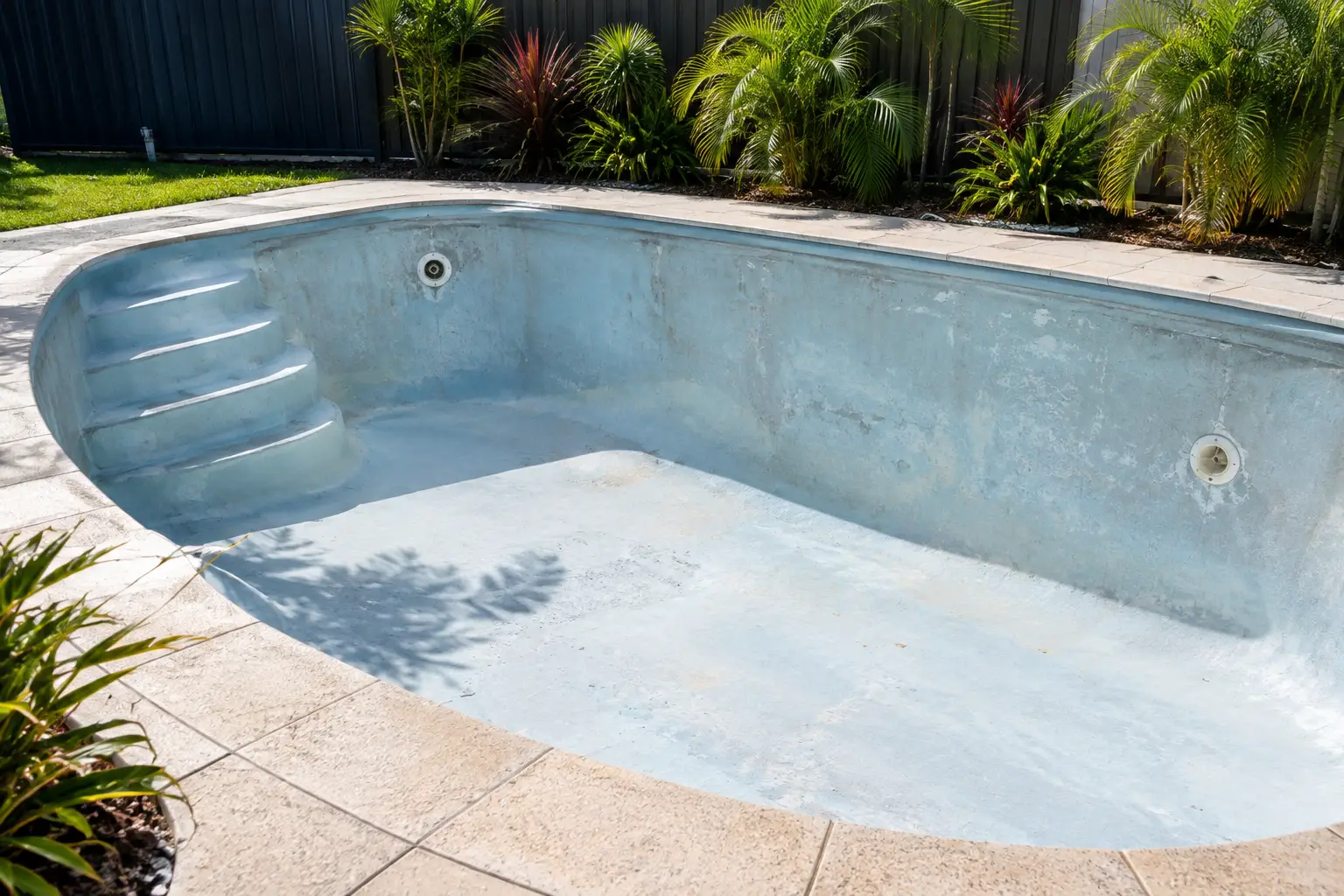
Peeling sheets of paint, soft patches underfoot, blisters and fading are not problems to paint over. Chlorinated rubber failure usually means something has gone wrong with the existing coating system, the surface beneath it, or the preparation completed before the last repaint. Finding the cause first is the difference between a proper repaint and another expensive failure.
For Australian pool owners and tradies, the first question is not simply which paint is best. It is: what is on the pool now, and is it still sound enough to coat? Chlorinated rubber pool paint can be the right choice for a compatible existing coating, but it will not fix loose paint, trapped moisture or an unknown surface.
What chlorinated rubber failure looks like
Chlorinated rubber coatings can fail in several ways, and the pattern often points to the underlying issue. If paint lifts in large sheets, adhesion has failed. If it bubbles or forms blisters, moisture, contamination or an application problem may be involved. If the coating is chalky, thin and worn through, it may simply have reached the point where preparation and recoating are required.
Look closely at where the failure occurs. Isolated peeling around steps, corners or repaired areas may indicate inadequate preparation in those sections. Widespread lifting across the pool is more likely to be a system-wide issue, such as recoating over incompatible paint or applying a new coat over a weak, degraded film.
Do not assume that a pool painted blue is necessarily coated in chlorinated rubber. Pools may have epoxy, chlorinated rubber, acrylic-based coatings or previous coatings that are difficult to identify. Colour is not evidence of compatibility.
The main causes of chlorinated rubber failure
Poor surface preparation
This is the most common cause of pool paint peeling. A new coating needs a clean, stable and properly abraded surface to bond to. If loose paint, chalking residue, dirt, oils, sunscreen residue or dust remain on the surface, the new paint is bonding to contamination rather than the pool.
Preparation also means removing failed material, not merely sanding its edges. A coating that looks mostly intact can still be weak underneath. Scrape and test suspect areas before committing to a full repaint. If paint releases easily, it is not a suitable base for another coat.
On concrete pools, preparation may also reveal bare or porous areas that need the correct compatible primer. Skipping primer where it is required can leave the topcoat with an uneven surface to bond to and may affect the finished result.
Recoating over an incompatible paint
Pool paint systems are not interchangeable. Applying chlorinated rubber over an incompatible existing coating can lead to wrinkling, softening, poor adhesion or later peeling. The same concern applies when changing from chlorinated rubber to another system.
If the existing coating is confirmed as sound chlorinated rubber, recoating with a compatible chlorinated rubber pool paint may be the practical option. If the coating type is unknown, do not rely on a guess. A small test area and the relevant product information can help establish whether the proposed system is suitable.
If the existing coating is extensively failing, changing paint type without fully removing the failed coating does not solve the problem. The new paint remains dependent on the weak layer below it.
Moisture in the substrate or coating
Concrete holds moisture, particularly after wet weather, washing or inadequate drying time. Sydney and NSW conditions can make timing difficult, especially when a pool is prepared during humid periods or after repeated rain. Coating a damp surface can cause blistering and adhesion loss once the pool is returned to service.
Moisture can also be a concern where water is entering through cracks, fittings or other defects. Paint is not a structural repair product. If there is a substrate issue allowing water behind the coating, it needs to be properly assessed and addressed before repainting.
Insufficient coating thickness or incorrect application
A pool coating needs to be applied as a complete system, following the product instructions for mixing, thinning where permitted, spreading rate, recoat timing and number of coats. Stretching paint too far to make a tin cover more area can leave insufficient film thickness. Applying too heavily can also create problems, particularly if the coating does not cure as intended between coats.
Hot weather adds another variable. On a very warm pool shell, paint can flash off quickly, making it harder to maintain an even coat. Plan the work around suitable conditions and work in manageable sections. Do not rush application simply because the pool has been emptied and prepared.
How to assess a failed coating before you buy paint
Start with a practical inspection. Scrape around peeling edges and test several areas, not just the worst patch. If the surrounding coating is firmly bonded and does not soften or lift, it may be possible to remove failed sections, feather the edges and prepare the sound coating for recoating. The exact approach depends on the coating type and substrate.
If lifting is widespread, if the coating is soft, or if multiple previous layers are separating, expect more extensive removal and preparation. Painting over broad failure is false economy.
You should also establish whether the pool is concrete or fibreglass. These surfaces have different preparation and primer requirements. A primer suitable for bare or repaired concrete is not automatically the correct product for a fibreglass pool, and primer is not a universal answer to an incompatible existing coating.
Before ordering, confirm four things: the pool surface, the existing paint type where possible, the extent of failure, and whether bare substrate will be exposed after preparation. These details determine whether chlorinated rubber pool paint, a two-pack epoxy system or a compatible primer is the appropriate next step.
Choosing the right coating system after failure
Chlorinated rubber pool paint is generally considered where the existing surface has a compatible chlorinated rubber coating that is still well bonded after cleaning and preparation. It can be a sensible repaint option when you are maintaining the same compatible system rather than trying to cover an unknown or failing coating.
Two-pack epoxy pool paint is a different coating system and may suit particular concrete or fibreglass repainting projects, subject to the existing surface, preparation requirements and product guidance. It is not a shortcut for coating over failed chlorinated rubber. If the old coating is unsound, the preparation work comes first regardless of the new paint selected.
Where bare concrete is exposed, use the primer specified for the coating system and substrate. Do not substitute a general-purpose primer or assume that extra primer will compensate for poor preparation. The correct primer supports the system. It cannot hold down loose paint.
Pool Paint Sydney supplies BG Coatings chlorinated rubber pool paint, two-pack epoxy pool paint and compatible primer systems. Check the relevant product page and technical information against your pool surface and existing coating before placing an order. If you are uncertain about compatibility, get clarification before applying any product.
Avoid the repeat-failure mistakes
Most repeat failures come from trying to save time at the wrong stage. Avoid coating over chalking paint, using the wrong system over an unknown coating, applying paint to a damp surface, skipping required primer on bare substrate, or ordering too little product and applying it too thinly.
Quantity matters because a pool is not a flat rectangle. Walls, deep ends, steps, ledges and internal features all add area. Use the Pool Paint Calculator before ordering paint and primer, then check that the calculated quantity matches the coating system and number of coats specified in the product information. This helps avoid running short mid-job or trying to stretch the final coat.
If a failure is limited and the remaining coating is truly sound, careful local preparation may be appropriate. If failure is widespread, allow for the extra preparation work. It is usually the preparation, not the paint tin, that determines whether the next coating has a sound base.
Before selecting chlorinated rubber pool paint, take the time to identify what has failed and why. A compatible coating system, the right primer where required and accurate quantities give you a far better starting point than painting over a problem you have not yet solved.