
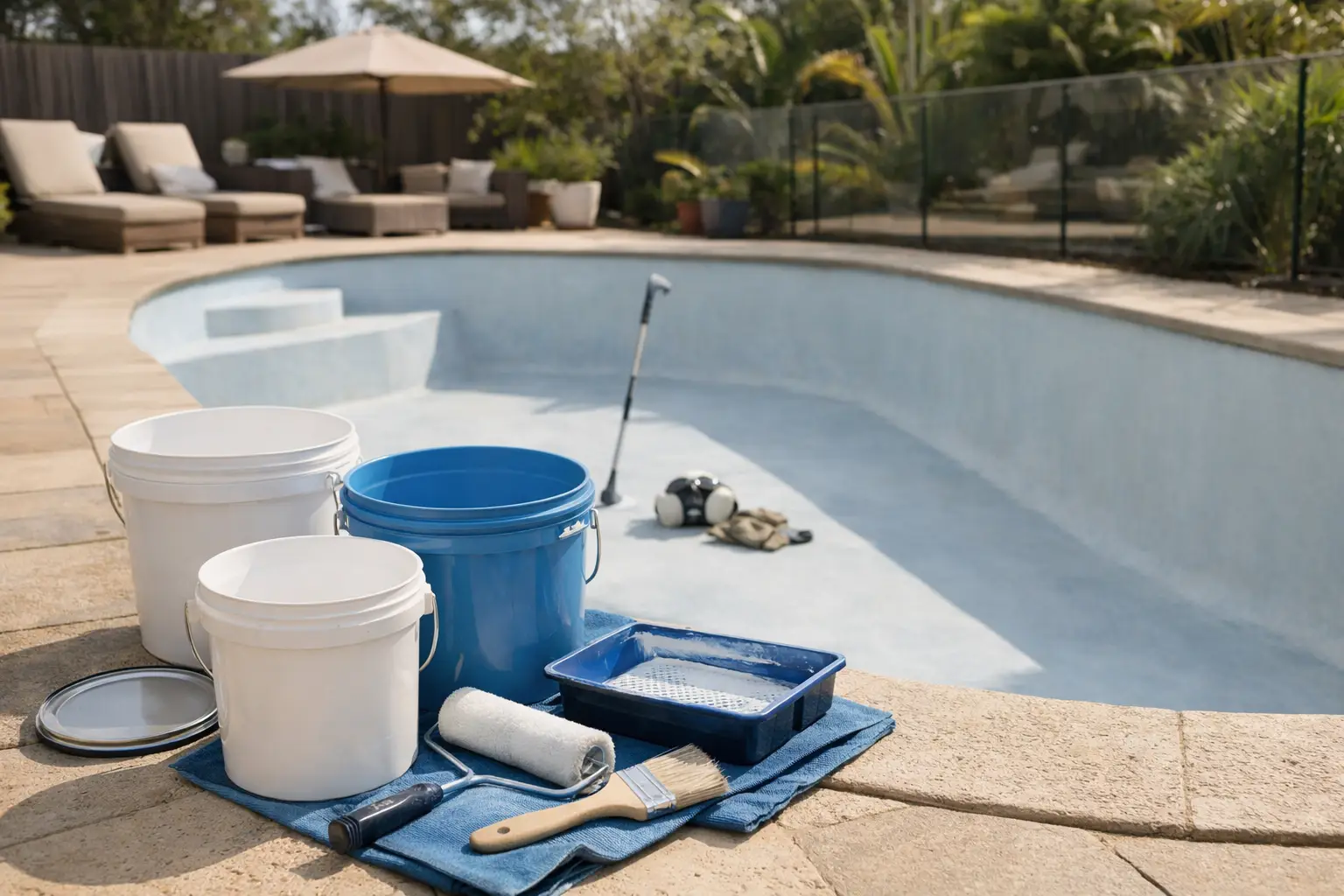
Running out of paint halfway through the second coat is an expensive way to find out your estimate was wrong. When working out how much epoxy pool paint to buy, the pool’s water volume does not matter. What matters is the total internal surface area, the number of coats, the coating system selected and whether a compatible primer is required.
For most repainting jobs, the safest approach is to measure carefully, calculate the full coating area, allow for the specified number of coats and round up to complete kits. Buying too little can leave you trying to match batches or delaying the job. Buying far too much is avoidable when the pool is measured properly before ordering.
How much epoxy pool paint is needed for your pool?
Two-pack epoxy pool paint is applied to the floor, walls, steps, benches, ledges and any other painted internal surfaces. Start with the pool’s length, width and average depth, then include the wall area rather than relying on the floor measurement alone.
A basic rectangular pool calculation looks like this:
Floor area = length x width
Wall area = perimeter x average depth
Add these figures together, then include the area of steps, swim-outs, ledges and other features. That final number is the approximate surface area to be coated.
For example, a 10 m x 4 m pool with an average depth of 1.5 m has a 40 m² floor. Its perimeter is 28 m, so the walls add about 42 m². Before allowing for steps, the coating area is already about 82 m². A calculation based on the floor alone would be well short.
Once you have the surface area, use the published coverage rate for the specific BG Coatings epoxy product and calculate for every required coat. Coverage figures are guides based on correct film thickness and a prepared surface. Rough concrete, porous areas and detailed features can use more material than a smooth, sound surface.
The Pool Paint Calculator is the practical starting point. Enter the pool dimensions and surface details, then check the result against the relevant epoxy product information before placing an order. If your pool has an unusual shape, a deep end, wide entry steps or extensive ledges, measure each section separately rather than forcing it into a simple rectangle.
Do not calculate for one coat when the system needs two
This is the most common quantity mistake. A coating may appear to cover the pool after the first coat, but that does not mean the specified system is complete. Epoxy pool coatings are generally applied as a two-coat system, subject to the product directions and the condition of the surface.
Calculate the material required for the total number of coats from the beginning. Do not plan to buy enough for one coat and decide later whether to apply another. Apart from delaying the project, separate orders may create problems with availability and batch consistency.
Also factor in the application method. Roller application, brush work around fittings and additional work on steps can affect real-world use. Do not deliberately stretch paint beyond its stated coverage rate to make a kit go further. Applying too thinly can compromise the coating system and may leave inconsistent colour or protection.
Primer can change the amount you need to order
Epoxy primer is not an optional extra to add automatically to every pool. Whether it is needed depends on the pool shell, the existing coating and the preparation method.
Bare or highly porous concrete commonly needs a compatible primer to help manage the surface before the topcoats are applied. A pool that has been fully stripped back may have different primer requirements from one with a sound, compatible epoxy coating that is being recoated. Fibreglass also needs the correct assessment and preparation, not a blanket assumption that any epoxy product will suit it.
Primer is calculated separately from epoxy topcoat. It has its own coverage rate, and it must be applied across the areas specified for the chosen system. If the pool has isolated bare patches after preparation, those patches may need spot priming rather than a full prime, but this depends on the product directions and substrate condition.
The costly mistake is ordering epoxy only, then discovering bare concrete or exposed repair areas need a compatible primer before you can continue. Identify the substrate and existing coating before you calculate quantities.
Your existing coating determines the right system
Before deciding how much epoxy pool paint to buy, work out what is already on the pool. Epoxy is not a universal topcoat for every existing painted surface. Applying an incompatible coating system can lead to peeling, poor adhesion or other early coating failure, even if you have calculated the quantity perfectly.
If the old coating is known to be epoxy and is sound, a compatible epoxy recoating system may be appropriate after thorough preparation. If it is chlorinated rubber, or the coating type is uncertain, stop and confirm compatibility first. A simple solvent test and inspection can help identify the existing coating, but unclear or mixed coatings need careful technical advice before product selection.
Look for signs that the old paint is not suitable to coat over: widespread peeling, flaking layers, soft paint, blistering, loose edges or contamination that cannot be properly removed. Paint applied over unstable material is only as reliable as the failing layer beneath it.
In these situations, the answer is not to order extra epoxy. The answer is to remove unsound coating, prepare the stable substrate and select the correct primer and topcoat system. Pool Paint Sydney can help customers confirm the appropriate product path before they order.
Measure the areas people often miss
A pool with a simple floor and four walls is straightforward. Most pools are not that simple. Small surfaces add up quickly, particularly in older Sydney backyards where pools often have broad steps, curved corners or shallow lounging areas.
Include all of the following where they will be coated:
- entry steps, benches and swim-outs
- waterline tiles or coping returns only if they form part of the paintable surface
- deep-end walls and sloping floors
- internal ledges, spas connected to the pool and raised sections
- feature recesses and other detailed concrete or fibreglass areas
Curved and kidney-shaped pools should be broken into manageable sections. Measure the longest and widest points, then allow sensibly for curves and features. If the estimate is close to the capacity of a kit, round up rather than assuming you will achieve perfect theoretical coverage on every section.
Allow for surface condition, but do not guess wildly
A little allowance is sensible. A heavily textured concrete shell, porous areas or a pool with numerous steps can consume more coating than a smooth surface. Allowing for this is different from adding multiple unnecessary kits because the pool “looks big”.
First, calculate the measured area. Next, apply the manufacturer coverage rate and number of coats. Then make a modest allowance where the surface condition justifies it. This gives you a defensible quantity estimate rather than a rough guess.
Do not use leftover paint from a previous project as part of the calculation unless it is the same compatible product, has been stored correctly and remains within its usable shelf life. Two-pack epoxy components must also be mixed in the correct ratio and used in line with the product instructions. Partial-kit mixing without accurate measuring can cause more problems than it solves.
A practical ordering check before you buy
Before ordering, confirm five things: the pool’s total paintable area, the existing coating type, the surface condition after preparation, whether primer is required and the number of epoxy coats specified for the system. These points determine the quantity far more accurately than the pool’s litres or a quick visual estimate.
If you are repainting a concrete pool with sound existing epoxy, your order may be primarily epoxy topcoat. If preparation exposes bare concrete, add the compatible primer required for those areas or for the complete substrate as directed. If the old coating is chlorinated rubber or unknown, confirm the correct coating system before ordering any epoxy.
Use the Pool Paint Calculator to build the initial estimate, then review the relevant product page for coverage, mixing and application requirements. For a pool with an uncertain coating history, detailed features or substantial peeling, ask for technical guidance before committing to a system. A careful calculation and the right coating choice are what help you buy the correct system the first time.