
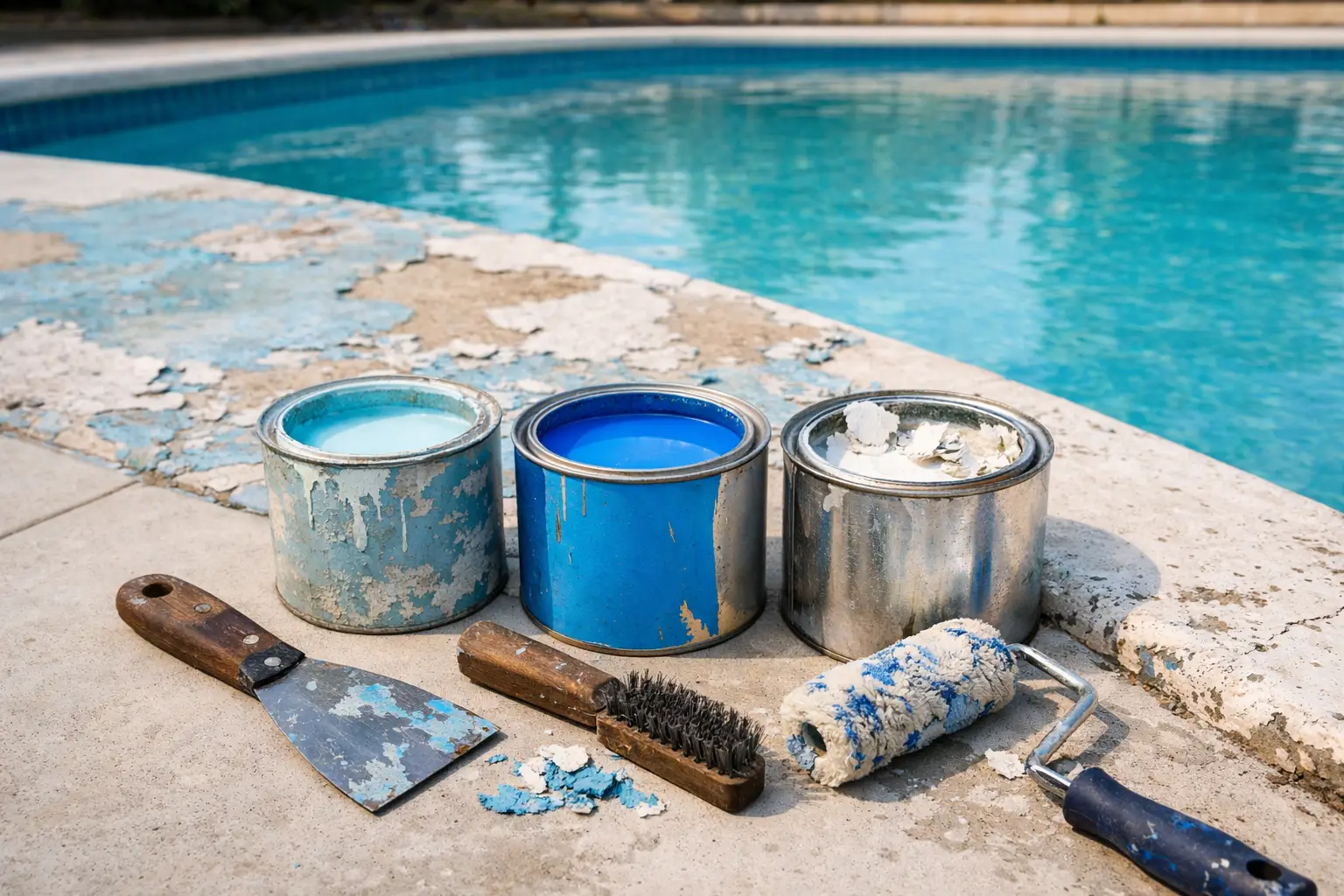
If your pool paint is peeling, chalky or patchy, the biggest risk is not the new paint itself – it is getting old pool paint compatibility wrong. Put the wrong coating over the existing surface and the fresh finish can lift, blister or fail well before it should. That is why the first job is not picking a colour. It is working out exactly what is already on the pool.
For most repaint jobs, the question is simple: can the new coating bond properly to the old one, or does the old finish need to come off first? If you want a long-lasting result, especially on a concrete or fibreglass pool in Australian conditions, that answer matters more than any sales pitch on the tin.
Why old pool paint compatibility matters
Pool coatings are not all interchangeable. Epoxy, acrylic and chlorinated rubber systems behave differently, cure differently and stick differently. Some can go over certain existing coatings with the right preparation. Some should never be applied over them at all.
This is where many DIY repaint jobs go wrong. The pool looks tired, the owner buys a product that sounds tough, and the new coating goes straight over whatever is already there. It may look good for a few weeks, but once the pool is filled, exposed to chemicals and hit by sun, weak compatibility shows up fast.
In Australia, that problem gets worse because pools cop hard UV, temperature swings and regular chemical exposure. A coating system that is only partly bonded does not usually get better with time.
How to identify the old pool coating
Before choosing new paint, you need a realistic idea of what the old coating is. If you know the previous product, that helps. If not, you need to inspect the surface and make a practical judgement.
Older pool paints are often acrylic, chlorinated rubber or epoxy. Epoxy is generally harder and less porous. Acrylic tends to weather faster and can feel softer or more chalky as it ages. Chlorinated rubber is less common in newer jobs but still turns up on older pools.
If the surface is heavily chalking, wearing thin or softening under solvent testing, it may not be a suitable base for an epoxy topcoat. If the finish is sound, well bonded and already an epoxy, repainting with another epoxy system is often the best option.
If you are unsure, treat that uncertainty seriously. Guessing is what causes expensive failures.
Signs the old paint is not a sound base
A new coating needs a stable surface. If the old paint is failing, no premium topcoat will fix that.
Watch for flaking, widespread peeling, blistering, hollow-sounding areas, deep chalkiness or layers that can be scraped off easily. These are not prep issues you can ignore. They usually mean the old coating has lost adhesion or broken down too far.
In that case, compatibility becomes less about what can stick on top and more about whether the old paint should remain at all.
What can go over what?
This is the part most buyers want a clear answer on, but the honest answer is that it depends on the existing coating and its condition.
As a practical rule, epoxy pool paint works best over a properly prepared existing epoxy coating that is still sound. That gives you the best chance of strong adhesion and long-term durability.
Applying epoxy over acrylic or unknown old pool paint is where the risk increases. Sometimes it can be done, but only if the surface is fully stable and tested properly. If the old coating is weak, chalky or incompatible, the new epoxy can fail because it is only bonded to a failing layer underneath.
Putting acrylic over old epoxy is also not a simple fix. Even if it sticks at first, you are usually stepping down to a less durable system. For pool owners who want a coating that handles chemicals, abrasion and Australian UV better, that is usually the wrong direction.
If the old paint type is unknown and the surface is questionable, full removal or aggressive preparation is often the safer option than trying to paint over it and hope for the best.
Old pool paint compatibility with epoxy coatings
For buyers looking at epoxy, the main question is whether the existing surface can support it. Epoxy pool coatings are popular for good reason – they are hard-wearing, water resistant and well suited to concrete and fibreglass pools when the substrate is prepared correctly.
But epoxy is not magic. It needs a clean, sound, mechanically prepared surface. If you apply it over loose, degraded or incompatible old paint, it will only be as reliable as the layer under it.
A sound old epoxy coating can often be recoated after thorough cleaning, sanding or abrasion, and any required repairs. That is usually the most straightforward repaint path.
An old acrylic or unknown coating needs more caution. If there is any doubt about adhesion, softness or breakdown, removal is often the smarter choice. It adds work upfront, but it can save you from a full repaint again next season.
When you should remove the old paint
There are jobs where overcoating makes sense, and there are jobs where stripping back is the only sensible move.
If the old coating is peeling in multiple areas, has several layers of different paints, feels brittle or soft in places, or has failed around steps, corners and waterline zones, patching over it is usually a short-term fix. The same applies if you do not know what is on the pool and cannot confirm that it is a stable base.
Removal is also worth considering when the pool has a long history of repainting. Multiple old layers can create thickness problems, poor intercoat adhesion and hidden weak spots. A fresh epoxy system performs better when it is built over a properly prepared substrate, not a stack of unknown coatings.
That does not mean every old pool must be stripped. It means you should be realistic. If the existing paint is the problem, new paint will not solve it.
Surface prep decides whether compatibility matters in practice
Even when the coating types are compatible, poor prep can still ruin the job. Dirt, calcium, oils, chalky residue and gloss all interfere with adhesion.
The pool surface needs to be properly cleaned, decontaminated and mechanically prepared. Any loose or suspect paint must be removed. Sound areas should be abraded so the new coating has a profile to grip to. Repairs should be completed before painting, not after the first coat.
Moisture also matters, especially on concrete pools. Damp substrate, hydrostatic pressure or painting before the shell is ready can lead to blistering and failure that gets blamed on compatibility when the real issue is preparation.
This is why product choice and prep choice have to go together. Buying the right epoxy coating is only half the job.
How to choose the right system the first time
If you are planning to repaint a pool, the best buying decision is usually the one that removes guesswork.
Start by identifying the pool type – concrete or fibreglass. Then assess the existing coating. If it is a sound epoxy surface, a quality epoxy repaint system is often the right path. If the old finish is unknown, badly worn or failing, do not choose on price alone. Choose the system based on whether the old coating can actually stay.
For many Australian pool owners, epoxy is the preferred option because it offers better durability than lower-grade alternatives. It is particularly suited to buyers who want a harder-wearing finish and do not want to repeat the job too soon.
If you are unsure how much paint you need, calculate properly before ordering. Under-ordering creates application issues, and over-ordering wastes money. Coverage depends on the pool size, surface condition and whether you are applying a full system or maintenance coats.
If you are buying online, get technical advice before you commit. A quick check on the existing coating and substrate condition can prevent the wrong purchase.
Common mistakes that cause repaint failure
Most pool paint failures come back to the same few mistakes. The first is assuming any pool paint can go over any old pool paint. The second is painting over failed or chalky coatings. The third is not preparing the surface properly.
Another common issue is choosing a cheaper system to save money, then paying for removal and repainting later. That usually costs more than buying the correct epoxy system from the start.
There is also the temptation to spot-fix problem areas and ignore the rest. That can work for minor repairs, but if the broader coating is unstable, local patching rarely holds up for long.
The practical way forward
If the existing coating is sound and compatible, repainting can be straightforward. If it is unknown or failing, treat that as the main problem to solve before you buy anything.
For pool owners and tradies who want a durable result, epoxy is often the right system – but only over the right surface. If you need help choosing the correct coating, checking old paint compatibility or working out quantities, Pool Paint Sydney can help you avoid the usual mistakes and buy the right system the first time.
A repaint lasts longer when you are honest about the old surface before you open the first tin.