
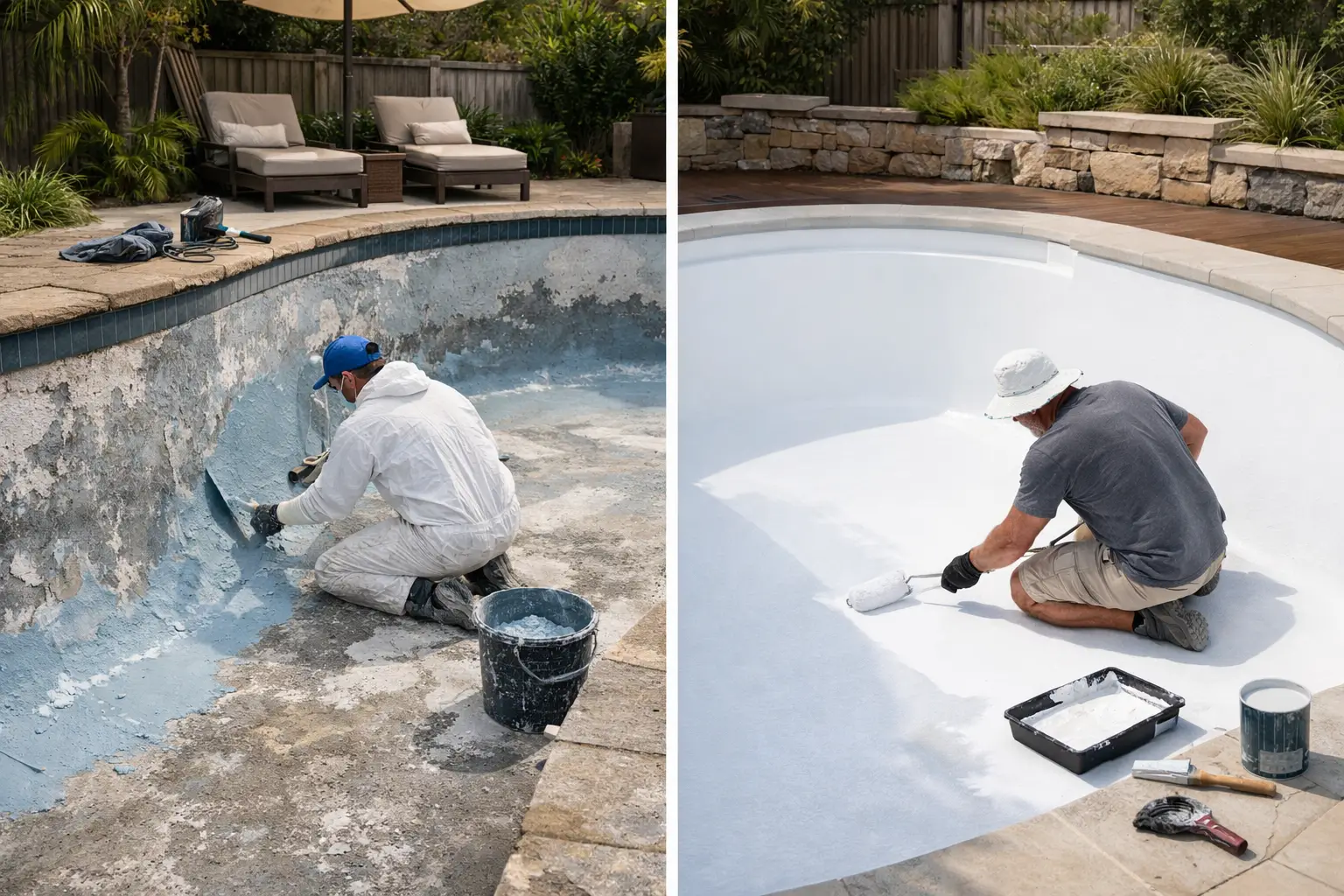
A rough, faded pool does not automatically need a major renovation. In the pool resurfacing vs pool painting decision, the first question is whether the problem is structural or simply a failed coating. Get that distinction right before ordering products and you can avoid spending money on the wrong solution.
Pool painting is a coating project. Resurfacing involves replacing or repairing the pool’s actual internal finish. They solve different problems, require different levels of work and should never be treated as interchangeable.
Pool resurfacing vs pool painting: the key difference
Pool painting is suitable when the pool shell and existing finish are fundamentally sound, but the coating is faded, stained, chalky, peeling or no longer providing an even appearance. The old coating must still be assessed carefully, but a compatible coating system can restore the finish without removing or replacing the pool surface itself.
Resurfacing is generally considered where the underlying concrete, render or fibreglass surface has deteriorated. Signs can include loose or hollow render, widespread cracking, exposed aggregate, major surface movement, damaged fibreglass or areas where the substrate is breaking down rather than just the paint film.
Painting over a failing substrate does not fix it. New paint will follow the condition of the surface below it, so loose material, moisture-related damage or unsound render can lead to early coating failure. If you suspect a structural or substrate issue, obtain qualified pool repair advice before planning a coating system. Pool Paint Sydney supplies coatings and technical product guidance, not resurfacing or repair services.
When repainting is usually the practical option
Repainting is commonly the more sensible path for an existing concrete or fibreglass pool with a sound surface and an ageing coating. It can be a good option when the finish has lost colour, become patchy, developed surface chalking or has localised peeling caused by poor preparation on the previous job.
The deciding factor is not just how bad the pool looks. It is what is currently on the surface. A pool that has been painted before needs a coating choice based on the existing paint type. Applying an incompatible product is one of the most common reasons a new finish lifts, wrinkles, softens or peels.
If the previous coating is known, selection is much easier. If it is unknown, do not guess based on colour or how old it appears. Check old tins or invoices if available, review any records from the previous owner, and inspect the coating condition. Where uncertainty remains, seek product-specific technical guidance before coating the entire pool.
Concrete pools
Concrete pools may have a painted finish, bare concrete, render or a previously applied coating system. Sound, previously painted concrete can often be recoated once loose and failed material has been removed and the surface has been prepared for the selected system.
Bare or porous concrete may require a compatible primer before topcoats are applied. Primer is not an optional extra added to every job. It is part of the system where the substrate and chosen coating require it. Skipping it when it is needed can compromise adhesion; using an unsuitable primer can cause the same trouble.
Fibreglass pools
Fibreglass needs a different approach because it is not simply porous concrete. The surface may have an existing coating, a gelcoat finish or areas of previous repair. A fibreglass pool with a stable, properly prepared existing coating may be suitable for repainting, but surface condition and coating compatibility still determine the correct system.
Do not assume a product suitable for concrete will suit every fibreglass situation without checking the product information. Careful cleaning, removal of loose coating, thorough sanding where required and the correct compatible primer or coating system matter more than rushing to apply paint.
When pool resurfacing is the better conversation
There are situations where paint is not the answer. If the surface is crumbling, cracking extensively, delaminating in large sections or showing movement-related damage, paint cannot rebuild it. Similarly, a fibreglass shell with significant substrate damage needs repair advice before any coating is considered.
A useful test is to look at the failure closely. If only the coloured coating is coming away while the surface below remains hard and sound, repainting may be viable after correct preparation. If pieces of render, concrete or fibreglass are coming away with it, the issue goes beyond paint.
This is where owners can lose money by choosing the cheaper-looking option first. A coating system is designed to coat a prepared, stable surface. It is not a substitute for structural repair or resurfacing work.
Choose the coating system before you start preparation
Once repainting is confirmed as appropriate, select the coating system based on the existing surface and old coating. Preparation requirements depend on that choice. Preparing the pool first and deciding on paint later can leave you with the wrong surface profile, missed primer requirements or unnecessary work.
Two common pool coating options are two-pack epoxy pool paint and chlorinated rubber pool paint. Neither is simply “best” for every pool.
Two-pack epoxy pool paint
A two-pack epoxy system is often considered for suitable concrete and fibreglass pool repainting projects where its compatibility and preparation requirements are met. Because it is a two-part product, mixing must be done accurately and application needs to follow the official product instructions, including limits around recoat timing and conditions.
Epoxy is not a sensible choice if it is incompatible with the existing coating. Applying it over the wrong surface can turn a straightforward repaint into a stripping job. Confirm the existing finish and use the relevant epoxy product and primer information before ordering.
Chlorinated rubber pool paint
Chlorinated rubber pool paint is commonly selected for pools with compatible chlorinated rubber coatings. It can be the practical route when recoating like-for-like, provided the existing surface is well adhered and properly prepared.
The critical word is compatible. Do not move between coating types because one product appears easier to apply or is available in the preferred colour. A compatible system, applied to a properly prepared surface, is far more important than choosing on convenience alone.
Preparation is what separates a repaint from a repeat failure
Most pool paint problems start before the first coat goes on. Peeling paint is often blamed on the product, but the cause is frequently loose old coating, contamination, poor sanding, moisture in the substrate, incorrect primer use or an incompatible coating system.
Start by removing failed and loose paint. A new coating cannot bond reliably to material that is already lifting. Edges of sound old paint should be feathered where appropriate so they do not show through as sharp steps after recoating.
The surface then needs to be cleaned and prepared according to the selected product system. Dust, residue and contaminants can interfere with adhesion, while rough or poorly prepared areas can produce an uneven finish. In Sydney and across NSW, hot conditions can also shorten workable application windows, so plan the job around the product directions rather than painting through unsuitable weather.
Before opening paint, check that the pool is empty, dry and ready for coating. Measure the pool carefully, including walls, floor, steps, ledges and other painted areas. Under-ordering can create avoidable delays, while buying only by water volume will not tell you how much coating is needed.
Calculate quantities before ordering
Use the Pool Paint Calculator to estimate the paint and primer required for your pool dimensions and selected system. It is a practical first step, but accurate measurements still matter. Measure length, width and average depth carefully, then account for steps, swim-outs, ledges and unusual shapes.
Also allow for the specified number of coats. Trying to stretch product further than its stated coverage may leave insufficient film build and an inconsistent result. Ordering the correct quantity from the start helps keep the coating system consistent across the full job.
When reviewing product options, check the relevant two-pack epoxy pool paint, chlorinated rubber pool paint and compatible primer product pages. If the old coating is unknown, the surface is partly bare or the pool has a history of peeling, ask for technical guidance before choosing a system.
A repaint can be a practical, cost-conscious way to restore a sound concrete or fibreglass pool. The result depends less on the label on the tin than on an honest assessment of the surface, a compatible coating choice and preparation done properly before the first coat is applied.