
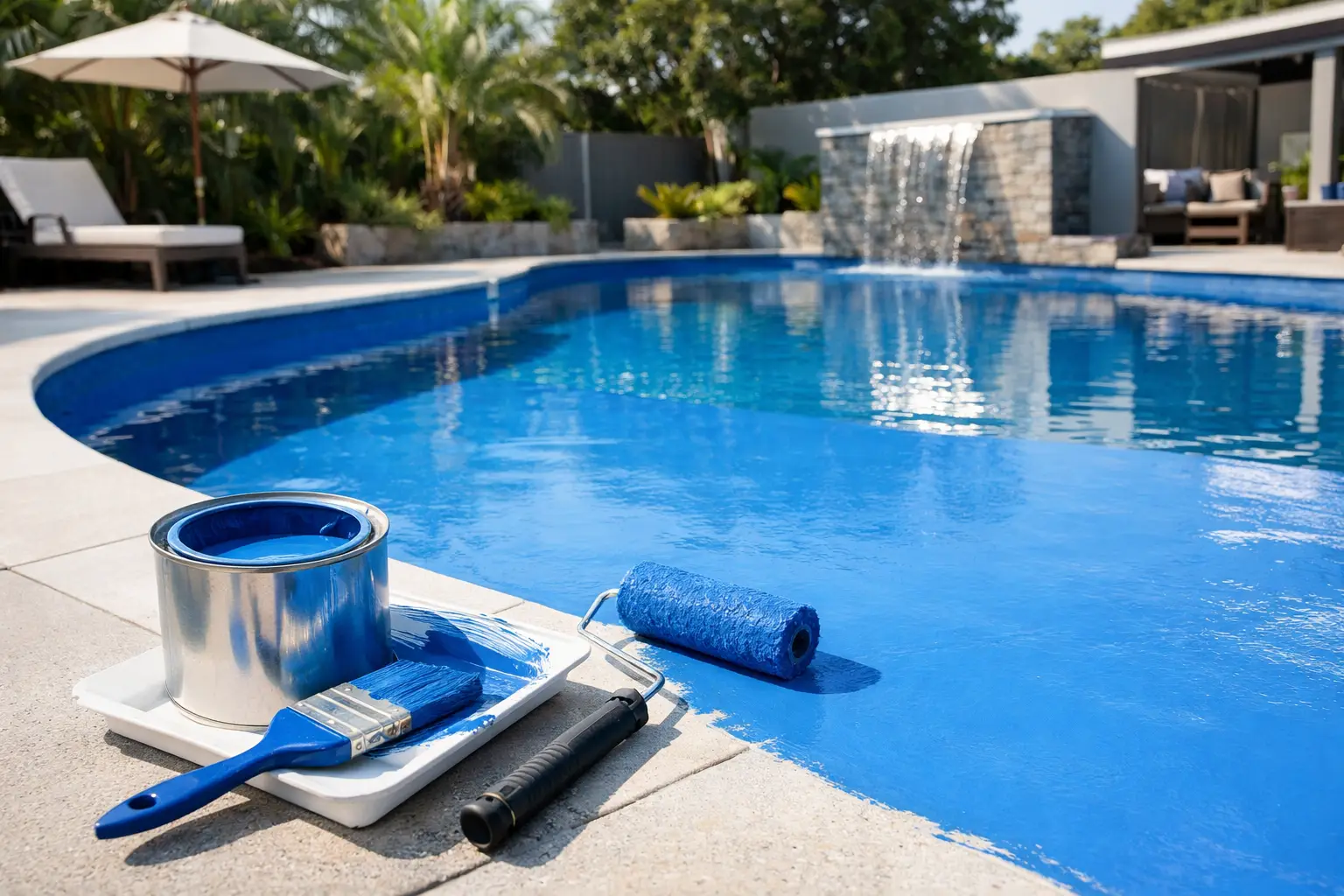
A pool that looked fine five years ago can start letting go fast in an Australian summer. The usual signs are chalking, fading, blistering or sheets of old coating lifting off once the water is out. If you are searching for epoxy pool paint Australia options, you are probably not after theory. You want to know what will last, what will fail, and how to avoid doing the job twice.
Epoxy is usually the right choice when you want a hard-wearing coating for a concrete or fibreglass pool and you want better resistance to chemicals, surface wear and water exposure than cheaper paint systems can offer. But epoxy only performs properly when the surface is right, the old coating is identified correctly, and the coverage is calculated properly. That is where most repainting jobs go wrong.
Why epoxy pool paint suits Australian conditions
Australian pools cop a hard life. UV, heat, salt, chlorine, sunscreen, leaf stain, and long dry periods between maintenance all put pressure on a coating system. A proper epoxy pool coating is designed to handle that better than basic pool paints.
The main reason buyers choose epoxy is durability. It forms a tougher film, stands up better to regular pool chemicals, and gives a more solid finish on both concrete and many fibreglass surfaces when the correct system is used. For homeowners planning a full repaint, or tradies who do not want callbacks for premature failure, that matters more than saving a bit on the tin price.
That said, epoxy is not magic. If the surface is damp, contaminated, flaky or coated with an incompatible old paint, even a good epoxy system can peel. The product matters, but prep and compatibility matter just as much.
Choosing epoxy pool paint Australia buyers actually need
The best product is not the one with the loudest label. It is the one that matches the pool surface, the existing coating and the condition of the shell.
For bare concrete pools, epoxy is often the preferred option because it gives a tough, long-lasting finish when applied over properly prepared masonry. If the concrete has old paint on it, you need to know what that coating is before repainting. Putting epoxy over a weak or unsuitable old coating can lock in a failure point underneath. The top layer may look good at first, then start lifting because the old layer lets go.
For fibreglass pools, product choice is even more specific. Some coatings are suitable, some are not, and surface prep needs to be done carefully to create the right key without damaging the substrate. This is one area where guessing is expensive.
If you are buying online, the smart move is to match the system to three things: substrate, current coating, and overall condition. That is the difference between a repaint and a re-do.
What causes epoxy pool paint failure
Most failed pool paint jobs are not caused by the epoxy itself. They are caused by what happened before the first coat went on.
Wrong product over the wrong surface
This is the big one. If the old pool paint is rubber-based, acrylic, marbled with unknown patches, or half-detached already, applying epoxy over it does not fix the issue. It can make the failure more obvious and more costly to repair later.
Poor surface preparation
Pool paint does not stick well to chalky residue, grease, calcium build-up, algae contamination or loose paint edges. Concrete also needs the right profile. Too smooth and the coating struggles to bond. Too dirty and it bonds to the contamination instead of the pool.
Moisture problems
A pool shell can hold moisture, especially after washing, acid treatment or weather exposure. Painting too soon can trap moisture under the coating and lead to blistering or adhesion loss.
Not enough paint applied
Trying to stretch coverage to save money often leaves the film too thin. Thin coats wear faster, can look patchy, and may not give the protection the system is designed to provide. This is why quantity calculation matters.
How to tell if your pool is ready for epoxy
Before buying paint, work out whether your pool needs a standard repaint, major prep, or full coating removal.
If the existing coating is sound, firmly bonded and compatible, a properly prepared repaint can work well. If you are seeing widespread peeling, multiple old paint layers, soft edges, powdery residue, or unknown previous products, assume more prep is needed until proven otherwise.
Concrete pools with bare or mostly bare surfaces are usually more straightforward, provided cracks, hollow patches and contamination are dealt with first. Fibreglass pools need extra care around sanding, cleaning and system selection.
This is the point where good technical advice saves money. Sending through photos, dimensions and a quick description of the current coating condition can help you avoid ordering the wrong system.
How much epoxy pool paint do you need?
Under-ordering is one of the most common DIY mistakes. Buyers often measure the pool roughly, forget the hopper or steps, and then try to make the paint go further than it should.
Start with the actual painted area, not just the water volume. Measure the length, width, wall height, floor profile and any stairs, ledges or swim-outs. A deep end, rounded corners and irregular shapes all add area. Once you know the square metres, match that against the stated coverage rate for the primer and topcoats.
Be realistic. Coverage on paper is one thing. Coverage on an older, more porous or rougher pool surface is often lower. If the substrate drinks in the first coat, that is normal. It is also why guessing from the size of the pool alone can leave you short.
If you are between quantities, buying enough to complete the system properly is the safer choice. Running out mid-job is far worse than having a small amount left over.
Prep steps that make the difference
A long-lasting epoxy finish starts before the tins are opened. The pool needs to be fully drained, cleaned and assessed. Loose or failing paint has to come off. Grease, chalk, mineral deposits and other contamination need to be removed. Any repairs should be done before coating, not patched over after.
Concrete usually needs mechanical or chemical preparation to create a sound surface and proper profile. Fibreglass needs thorough cleaning and controlled abrasion to promote adhesion. Every surface must be dry enough and stable enough for coating.
Then there is timing. Australian conditions can help or hurt. Warm weather can be good for curing, but excessive heat, direct sun on a hot shell, unexpected rain, or painting outside recommended temperature windows can cause problems. The best result usually comes from planning the job around the weather, not forcing it into a weekend regardless.
When epoxy is the right buy and when it is not
Epoxy is a strong option for pool owners who want a durable coating and are prepared to do the prep properly. It is especially well suited to concrete repainting projects where the surface can be brought back to a clean, stable base.
It may not be the right move if the existing coating is unknown and heavily compromised, or if the pool needs extensive remediation before any new paint should go on. In those cases, the right advice is not “just paint over it”. It is to sort out the substrate first, then coat it properly.
That honesty matters because pool paint failures are rarely cheap. The labour is in the prep, not just the application. If you get the system wrong, you pay for that labour twice.
Buying epoxy pool paint online without making a mistake
Buying direct can save time, but only if you know what to order. The safest approach is to buy from a specialist supplier that deals specifically with pool coatings, not general paint. You want a supplier who can help with compatibility, quantity, prep requirements and application guidance before you purchase, not after the problem starts.
That is where a specialist store like Pool Paint Sydney can make the process easier. If you are not sure whether your pool needs epoxy, how much you need, or whether your old coating is suitable for recoating, get advice first and buy the correct system the first time.
The right order usually includes more than just the topcoat. Depending on the surface and condition, you may need the full coating system, repair materials and prep products to get a result that lasts.
A better result starts with the right decision
If your pool is peeling, faded or due for a full repaint, do not start by asking which paint is cheapest. Start by asking what surface you have, what is on it now, and what system will actually hold up in your conditions. That is how you avoid costly mistakes, get long-lasting results, and end up with a pool finish worth the effort.